

Beauty Makeup Editor & Camera
Photo & Video Editors - Instant Solution
I tried Beauty Makeup Editor & Camera as a quick beauty-editing tool rather than treating it like a full photo studio, and that distinction matters. Its focus is simple: take a portrait, experiment with makeup, refine the lips, and produce a more polished image without opening a complicated editor. I found it most useful when I wanted a fast visual change for a profile picture, a social post, or a private before-and-after experiment.
The app sits in the beauty category and is free to install, although it includes optional purchases ranging from $0.99 to $99.99 per item. It is made by Photo & Video Editors - Instant Solution, has a 4.7 average from around 435 thousand ratings, and has passed 50 million installs. Those figures suggest that it has reached a very broad audience, but popularity does not automatically make every editing choice right for every face or every household.
How it works in an everyday shared-device situation
The most realistic use case is a shared phone or tablet in a household. Someone may want to prepare a portrait for a messaging profile, another person may want to test a lipstick shade, and a teenager may simply be curious about how a stronger makeup look would appear. In that situation, the app is appealing because the basic idea is immediately understandable: open a portrait, work on the face, and compare the result with the original.
I would use it for a quick result rather than a long editing session. If I had ten minutes before leaving for an event, I could use the camera or a saved image to explore a lip color and decide whether the overall look felt balanced. That is a more convincing role for this app than trying to create a carefully retouched beauty campaign. Its value is speed and accessibility, not the kind of detailed control expected from a professional image editor.
On a shared device, I would begin by making sure the right person is using the right photo. This sounds obvious, but beauty tools are easy to hand from one person to another, and a saved portrait can remain visible in a gallery or recent-edit area. The app is best treated as a personal editing tool even when the phone itself belongs to the household.
Latest News

Uber Eats Under Pressure: What Happens When Delivery Goes Wrong

How QR & Barcode Scanner Adapts to Android and iOS Innovations

Why Waze Navigation & Live Traffic Is Your Essential Travel Companion
CapCut Mastery: Unleash Hidden Features for Pro-Level Editing

How OS Updates Enhance Roblox Adventures

Teacher Simulator: Exam Time Turns Quick Classroom Judgments into a Repetitive Loop
There is also a useful social boundary here. Editing someone else’s face without their permission may seem harmless when the result is only a joke, but a beauty filter can change how that person looks in a way they did not choose. I would ask before using another family member’s portrait, especially if the edited image might be shared. The app makes experimentation easy; it does not remove the need for ordinary consent.
What I noticed during the first session
The strongest part of the experience is the direct connection between the portrait and the makeup idea. Instead of beginning with a blank canvas and searching through unrelated tools, I could stay focused on facial appearance. That makes the app less intimidating for someone who has never used layers, masks, curves, or manual retouching.
The lipstick-oriented editing is particularly easy to understand. A lip color can change the mood of a portrait quickly, and the app’s beauty focus makes that kind of test feel more natural than it would in a general-purpose editor. I found this useful for comparing a subtle everyday shade with a more noticeable evening style before making a real purchase or applying makeup.
Gallery
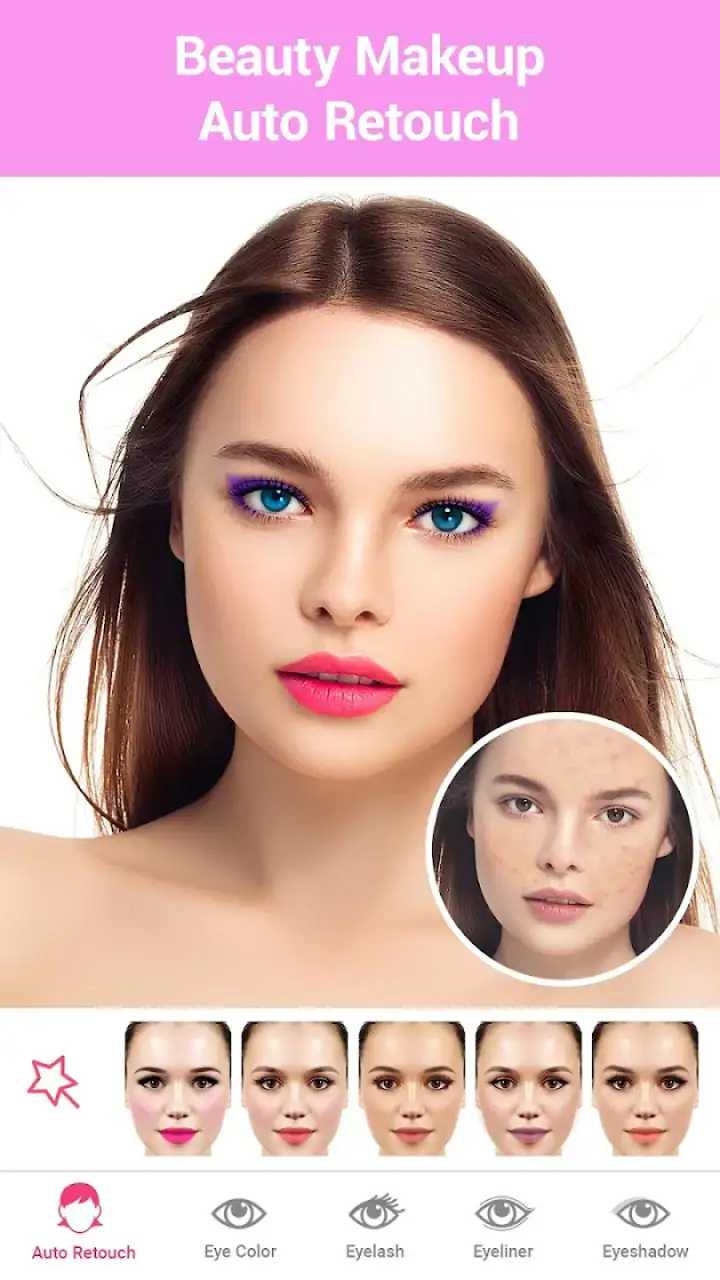
My main caution is that a virtual result should be treated as an approximation, not a promise of how a product will look in person. Lighting, camera white balance, skin tone, texture, and the condition of the original photo all affect the result. A shade that looks flattering in an edited portrait may still look different under daylight or indoor lighting. I would use the app to narrow down ideas, not to make a final beauty decision on its own.
Setting boundaries before several people use it
Because the app is designed for Everyone and can be used by people with very different expectations, a little household coordination helps. I would decide in advance whether the app is being used for private experimentation, for preparing images to share, or simply for entertainment. These are different activities, and confusion usually starts when one person assumes an edited image will stay private while another person treats it as ready for publication.
The app is available on devices running Android 7.0 or later, so compatibility is broad enough for many older phones. That is useful in a shared household where the newest device is not always available. Still, the editing experience depends heavily on the quality of the camera and screen. An older phone may display a less convincing preview or produce a portrait with weaker detail, even if the app itself installs normally.
I would also keep the original portrait separate from the edited copy. The safest workflow is to preserve the unedited image first, then experiment freely. That matters because a strong beauty adjustment can be difficult to undo once several changes have been made, and a shared device makes accidental overwriting more likely. Keeping both versions also makes it easier to judge whether an edit is improving the portrait or merely making it look less natural.
Another practical boundary concerns purchases. The app is free, but optional in-app items can cost from $0.99 to $99.99 each. On a device used by several people, I would make sure everyone understands that “free to install” does not mean every optional element is free. An adult should handle purchase decisions, particularly when a child or guest is exploring the app casually.
I would not assume that a shared-device arrangement creates separate personal spaces inside the app. If several people use the same phone, they should coordinate manually about which images are being opened, edited, or saved. A simple household rule—use your own photos, ask before using someone else’s, and do not buy anything without permission—covers the most important risks without making the experience unnecessarily formal.
A workflow that avoids most household friction
Choose a portrait that the person in the image has agreed to edit.
Save or preserve the original before making changes.
Try one makeup adjustment at a time, especially when comparing lip colors.
Show the edited result to the person pictured before sharing it anywhere.
Leave purchase decisions to the device owner or another agreed adult.
This workflow is more important than it may appear. When an app is quick and playful, people tend to tap through changes without stopping to decide what the final image is for. Separating experimentation from sharing keeps the app enjoyable while reducing misunderstandings between family members.
Coordinating edits, opinions, and expectations
Beauty editing is subjective, so coordination is not only about privacy. One person may prefer a natural result, while another may enjoy a clearly stylized face. I found that the easiest way to avoid arguments is to describe the goal before editing: “I want a realistic profile photo,” “I am testing a lipstick idea,” or “I am making a playful image.” The same adjustment can be successful or disappointing depending on that goal.
For a natural portrait, I would make small changes and check the image at normal viewing size instead of zooming in constantly. Zooming can make minor details seem more important than they are, while a portrait is usually seen as a whole. For a playful image, stronger makeup can be part of the point, but I would label it clearly if it is shared so that nobody mistakes it for an untouched photograph.
One non-obvious advantage of a focused beauty app is that it reduces the number of decisions. A general editor may offer dozens of unrelated controls, which is useful for experienced users but tiring for someone who only wants to adjust facial appearance. Here, the narrower purpose can help a household member who wants a quick answer rather than a lesson in photo editing.
The trade-off is precision. If I wanted to correct a very specific edge, remove a distracting object, balance the background, or perform careful skin retouching, I would probably choose a more advanced editor. A beauty camera can make a face look more polished, but it is not automatically the best tool for every part of a portrait. I would use it for the face and then move to another app only if the image needed broader correction.
Another practical tip is to compare the edited image with the original after taking a short break. Beauty adjustments can become excessive when viewed repeatedly, because the eye quickly adapts to the new version. Looking again after a few minutes makes it easier to notice blurred texture, overly strong lips, or a result that no longer resembles the person. This is especially helpful when several household members are giving opinions at once.
Where it fits beside common alternatives
Compared with a standard camera app, this one is more purposeful for makeup experiments. A normal camera is better when I want an unmodified record of how I look, but it does not offer the same beauty-oriented direction. Compared with a general photo editor, Beauty Makeup Editor & Camera is easier to approach for facial changes, while the general editor usually wins when I need detailed, selective control over the entire image.
Compared with buying makeup immediately, the app offers a low-cost way to explore an idea first, but the preview cannot reproduce real texture, wear, or lighting perfectly. Compared with a professional retouching workflow, it is faster and less demanding, but it gives me less control over subtle corrections. I would choose it when convenience matters more than exactness.
This makes the app particularly suitable for casual users, people preparing quick social portraits, and anyone curious about lipstick or makeup variations. I would skip it if my main goal were untouched photography, professional retouching, or a detailed catalog of cosmetic products. I would also avoid relying on it as the only reference for a major purchase or an important public image.
Age, trust, and responsible use
The Everyone age rating makes the app approachable for a broad audience, but an age label does not settle every question about appropriate use. Children may see face editing as a game, while adults may see it as a tool for presentation. Both perspectives can coexist, yet younger users may need a clear explanation that edited images are not a measure of attractiveness and that online pictures often do not show reality.
I would be especially careful with repeated editing of a child’s face. Occasional, agreed-upon play is different from creating pressure to look filtered all the time. The app can be fun when the child controls the choice and understands that the result is imaginary styling. It becomes less healthy when adults use it to criticize natural features or when a young person feels that an unedited face is not good enough.
Trust also applies to sharing. A family member may be comfortable trying an edit privately but not comfortable seeing it posted in a group chat or social profile. I would treat the edited image as belonging to the person pictured, not automatically to the person holding the phone. That simple rule works well for household use because it respects the difference between experimenting and publishing.
Since the app has been available since Jan 20, 2016, and its current version is 2.1.2, it has had a long presence compared with many short-lived beauty tools. I still would not use age or popularity as a substitute for judgment. The most important questions are practical: who is using the device, whose image is involved, whether the result is private, and who is allowed to approve optional spending.
For adults sharing the app with teenagers, I would demonstrate the editing process once and explain the difference between a preview and a real cosmetic result. That conversation can prevent disappointment later. It also gives the younger user a useful habit: evaluate an image for its purpose, not simply for how dramatically it changes a face.
Who should choose something else
I would point a professional creator toward a broader editor if they need repeatable brand styling, precise masking, or careful control over every part of a composition. I would also suggest a regular camera or an unfiltered workflow to someone who values an accurate record of their appearance more than experimentation. This app is not a replacement for every tool in the beauty and photography space.
People who dislike optional purchase prompts should approach the free installation with attention. The presence of items priced up to $99.99 means the device owner should understand how the app is being used before handing it to someone else. That does not make the app unsuitable, but it does make household communication part of the setup.
Finally, anyone expecting a perfect match between an edited lipstick shade and a real product may be disappointed. Screen brightness and portrait lighting can alter perception, and digital color is not the same as applying makeup to skin. I see the app as a visual sketchbook: useful for direction, less reliable as a final verdict.
My household verdict
After using it with a practical mindset, I see Beauty Makeup Editor & Camera as a friendly, focused option for quick face and lipstick experiments. Its free entry point, Everyone rating, broad Android compatibility, and straightforward beauty purpose make it easy to introduce to a shared household. The app is at its best when each person uses their own image, keeps the original safe, and agrees on whether the result is private play or something to share.
The biggest strength is not professional precision; it is the short path from portrait to visible idea. I can explore a makeup direction without learning a complex editor, and another family member can understand the result without needing technical knowledge. That makes it a useful choice for casual portraits, style comparisons, and lighthearted experimentation.
The limitations are just as clear. Shared devices need manual boundaries, optional purchases need adult attention, and edited beauty images should not be confused with real-life appearance or product testing. Users who need detailed retouching, untouched photographs, or strict control over every visual element will be happier with a different kind of app.
My recommendation is to try it when convenience and makeup experimentation are the priority, while keeping expectations realistic. Used with consent and a little coordination, it can be a pleasant addition to a household phone. I would recommend it to a friend who wants fast beauty previews, but I would also remind them to compare the result with the original, protect other people’s photos, and treat every optional purchase as a deliberate decision rather than an accidental tap.
FAQs for Beauty Makeup Editor & Camera
What features does the Beauty Makeup Editor & Camera offer?
The Beauty Makeup Editor & Camera app provides a range of features, including virtual makeup application, skin smoothing, blemish removal, and teeth whitening. It also offers a variety of filters and effects to enhance your photos. Users can try different hair colors and styles, making it a versatile tool for beauty enthusiasts.
Is the Beauty Makeup Editor & Camera app free to use?
The app is free to download and use with basic features. However, it offers in-app purchases for premium tools and filters that enhance the experience. These purchases can unlock additional makeup styles, advanced editing features, and ad-free usage, providing a more comprehensive editing toolkit.
How does the app ensure user privacy and data security?
The Beauty Makeup Editor & Camera app prioritizes user privacy by adhering to strict data protection policies. It only collects minimal data necessary for functionality and offers clear privacy settings. Users are encouraged to review the app’s privacy policy to understand how their data is used and protected.
Can I share edited photos directly from the app?
Yes, the app allows for easy sharing of edited photos directly to social media platforms such as Instagram, Facebook, and Snapchat. It also supports saving images to your device’s gallery, ensuring that you can easily showcase your enhanced photos to friends and followers.
Is the app suitable for beginners in photo editing?
The Beauty Makeup Editor & Camera app is designed with an intuitive interface, making it accessible for beginners. It offers easy-to-use tools and tutorials to guide new users through the editing process. Whether you're a novice or experienced editor, the app provides a user-friendly experience.
Pros
- User-friendly interface for easy navigation.
- Wide variety of makeup styles and tools.
- Real-time makeup application with AR.
- High-quality output for social media sharing.
- Regular updates with new features.
Cons
- Some features require in-app purchases.
- Occasional ads can disrupt usage.
- May require a high-performance device.
- Limited offline capabilities.
- Some filters can be overexposed.


